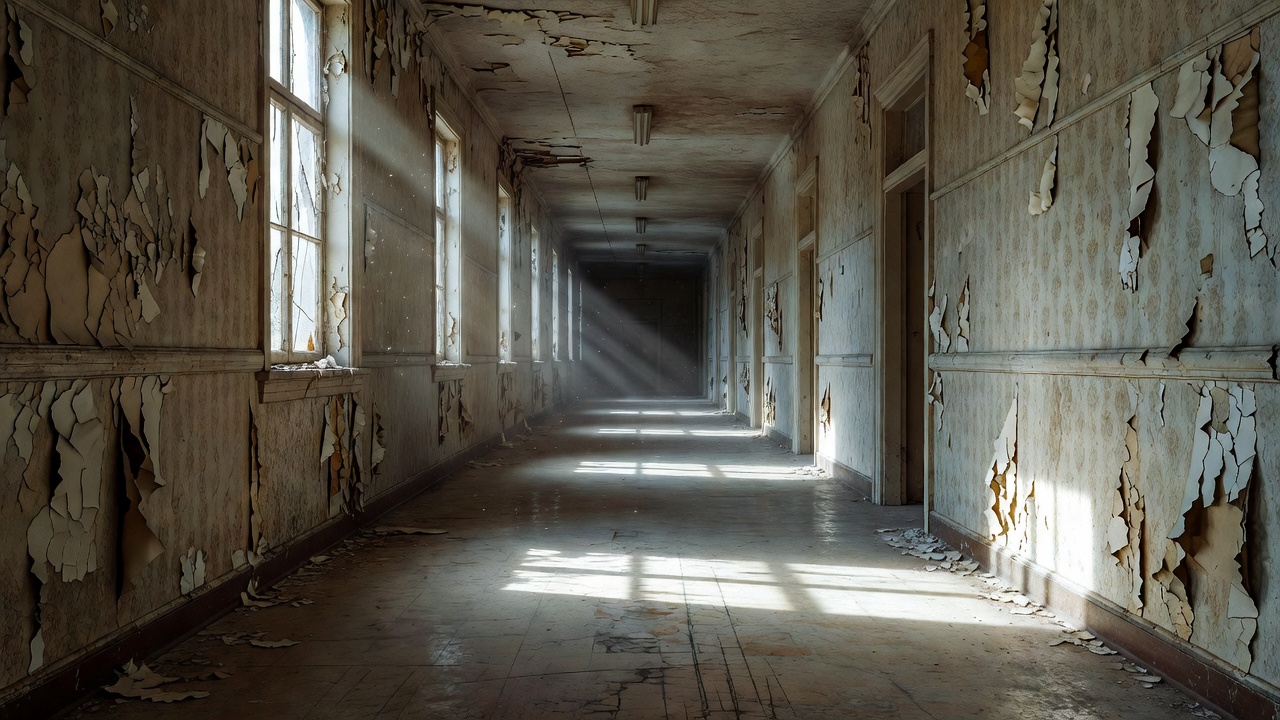
An interior is a sequence, not a moment
It is tempting to treat a deserted room as a frozen scene, as if everyone walked out on the same afternoon. In practice, most interiors are the result of long change: partitions added, services upgraded, furniture removed in stages, and years of weather and visitors since closure. Reading an interior means sorting those layers into an order.
Evidence to look for
- Fixings and ghosts. Screw holes, unpainted rectangles and shadow lines show where noticeboards, beds, benches or equipment once stood.
- Services. Gas pipes, early electric conduit, call-bell systems and radiators date phases of modernisation.
- Finishes. Paint layers, wallpaper and floor coverings can be counted at damaged edges. Hygienic glazed tiles and rounded corners suggest medical or food uses.
- Wear. Worn thresholds, scuffed skirting at trolley height and polished handrails reveal habitual routes.
- Signage. Door labels and painted instructions often survive longer than furniture and directly name a room's function.
Documented examples
Beelitz-Heilstätten, Brandenburg
Built in phases from 1898 as a large sanatorium complex for Berlin's workers, Beelitz-Heilstätten later served military uses, including as a Soviet military hospital until 1994. Parts have since been redeveloped, and a treetop walkway opened in 2015 gives lawful views over several buildings. Its architecture shows how ideas about air, light and separation shaped treatment of tuberculosis.
Hashima Island, Japan
Hashima, often called Gunkanjima, was a coal-mining settlement closed in 1974. Licensed tours began in 2009, and it was inscribed by UNESCO in 2015 as part of the Sites of Japan's Meiji Industrial Revolution. Visitors are restricted to designated areas because structures are unstable. The site's history also includes forced labour during the Second World War, which honest interpretation must acknowledge.
Staging, moved objects and honesty
Many interiors you see online have been rearranged: a doll placed on a bed, a wheelchair pushed into a beam of light. These images can mislead future researchers about how a building was left. In your own work, photograph objects where you find them. If you suspect a scene has been arranged by earlier visitors, say so in the caption rather than presenting it as original.
Privacy and dignity
Closed hospitals, care homes and schools sometimes contain records with names, diagnoses or photographs of real people. Do not photograph legible personal documents, and never remove them. Report them to the owner or the relevant authority so they can be secured. Treat chapels, mortuaries and memorials with the respect you would give them if they were still in use.
Verified history and inference
Room functions can often be confirmed from architectural plans, annual reports, local newspapers and oral history collections. Where you rely on the evidence of fittings alone, label your reading as an interpretation. "Probably a treatment room, based on tiled walls and a floor drain" is more useful than a confident but unsupported claim.
Physical risk. Interiors hide dangers: rotten joists beneath intact flooring, mould, asbestos insulation, broken glass and collapsed ceilings. Enter only where you have permission, with a companion, a torch and protective footwear.