Start with purpose, not mood
Photographs of derelict industry often lean on decay: broken glass, dripping water, dramatic light. Those images can be beautiful, but they say little about the building. The field archivist's first question is different: what did this structure have to do? A building designed to spin flax, roll steel or wind coal from a shaft had to meet specific demands for light, load, power and movement. Those demands shaped everything you can still see.
Begin each visit, whether from a public road or inside with permission, by asking how materials and power came in, how goods went out, and where the people worked. Loading doors stacked one above another point to hoists. Wide spans without columns suggest heavy machinery or cranes. Tall chimneys and boiler houses locate the power source before electrification.
Reading the structure
Several features recur across industrial buildings and help you date and interpret them:
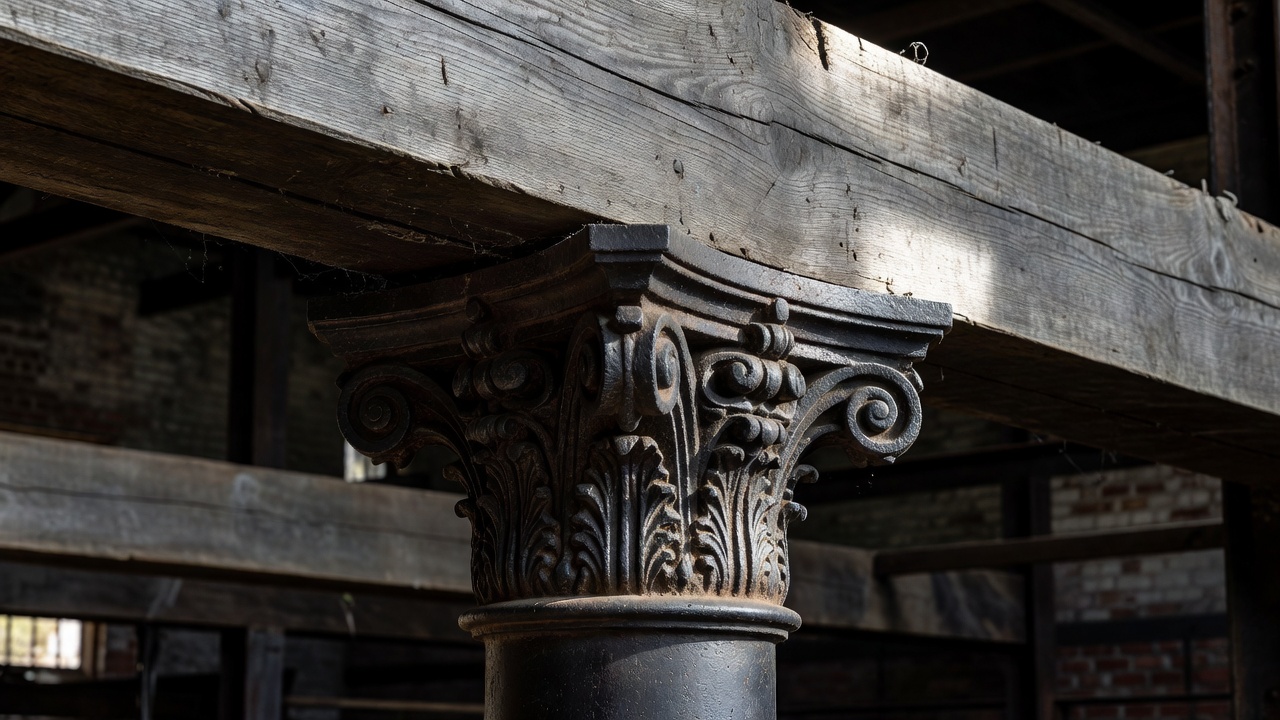
- Fireproof construction. Cast-iron columns and beams carrying brick jack arches were developed in late eighteenth-century British mills to reduce fire risk from cotton and flax dust.
- North-light roofs. The sawtooth profile, with glazing facing away from direct sun, gave even daylight for weaving and engineering work.
- Crane rails and gantries. Steel rails along the tops of walls indicate overhead travelling cranes and heavy assembly.
- Machine bases. Concrete plinths, bolt patterns and drainage channels in floors outline machines removed long ago.
- Line shafting evidence. Regular brackets along ceilings show where belt-driven shafts transmitted power before individual electric motors.
Case notes from documented sites
Ditherington Flax Mill, Shrewsbury
Designed by Charles Bage and built in 1796–97, the mill is widely recognised as the first iron-framed building. It spun flax until 1886, became a maltings in 1897 and was disused after 1987. The restored main mill reopened in 2022. Because its uses changed, the fabric holds several sets of evidence, and the maltings phase altered windows and floors.
Völklingen Ironworks, Saarland
Iron production at Völklingen ended in 1986. In 1994 it became the first industrial monument from the heyday of industrialisation to be inscribed as a UNESCO World Heritage Site. The blowing-engine hall and blast furnace platforms can be visited on managed routes, which is the appropriate way to photograph them.
Zollverein Coal Mine, Essen
Shaft XII, designed by Fritz Schupp and Martin Kremmer, opened in 1932. Mining ended in 1986 and the coking plant closed in 1993. UNESCO inscription followed in 2001. Its symmetrical steel-frame buildings show that functional industry could be consciously composed architecture.
Packard Automotive Plant, Detroit
Designed by Albert Kahn's office from 1903, the plant used reinforced concrete to create large, well-lit floors. Packard car production ended there in the 1950s, and the complex declined over decades. Demolition began in 2022. For sites like this, existing photographs and surveys become the surviving record, which is why careful captioning matters.
Landschaftspark Duisburg-Nord
The Meiderich ironworks closed in 1985 and opened as a public park in 1994. Here reuse keeps the furnaces, bunkers and ore yards readable, making it an excellent, lawful place to practise industrial photography.
Separating verified history from inference
Dates of construction, owners and closure can usually be checked in listing descriptions, company archives, trade directories and historic maps. Interpretations, such as which room housed which process, should be labelled as inference unless documented. When a local story says a building "closed overnight", look for the receivership notice or newspaper report before repeating it.
Physical risk. Industrial sites often contain asbestos lagging, lead paint, contaminated soils, open pits and corroded walkways. Only enter areas the owner has approved, with suitable protective equipment, and never alone.
Where to look for sources
In England, Historic England's list entries and local Historic Environment Records are a strong start. In the United States, the Historic American Engineering Record, founded in 1969, holds measured drawings and photographs of many industrial sites. Ordnance Survey and fire-insurance maps show how layouts changed decade by decade.